
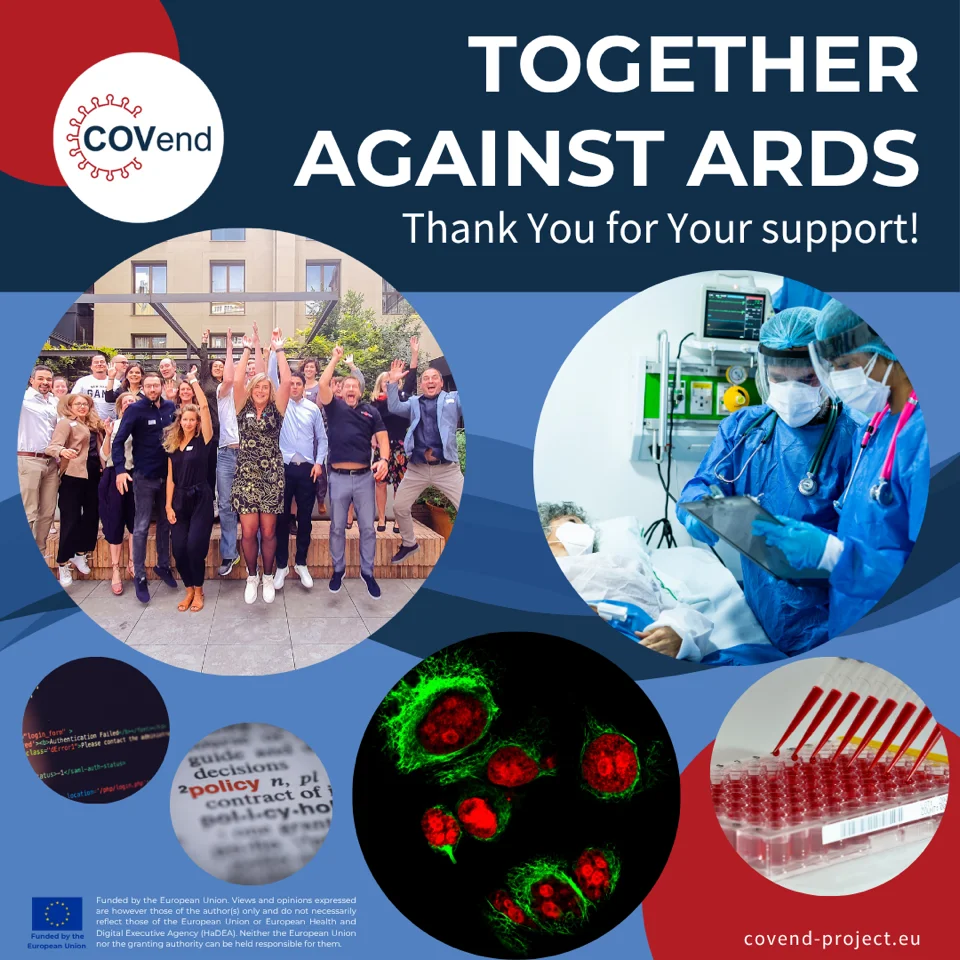
After four transformative years of research and collaboration, the COVend project (2021–2025) has officially reached its conclusion. Funded under Horizon Europe, COVend brought together 13 partners from eight European countries with a shared vision — to advance treatment options for acute respiratory distress syndrome (ARDS) through the development of an innovative peptide-based therapy, FX06.
The science behind FX06
During systemic inflammation caused by infectious diseases, trauma, or sepsis, the endothelial cell layer — the protective barrier lining our blood vessels — becomes damaged. This damage increases vascular permeability, allowing fluid to leak into surrounding tissues and accumulate in vital organs such as the lungs. The result can be acute respiratory distress syndrome (ARDS), a life-threatening condition characterised by hypoxia and prolonged mechanical ventilation.
FX06 is a naturally occurring peptide designed to stabilise the endothelial barrier, addressing one of the key mechanisms behind ARDS regardless of its underlying cause. By focusing on endothelial protection, COVend targeted a unifying pathway in inflammatory diseases, offering a potential breakthrough in how ARDS is prevented and managed.
Achievements and results
Over the course of the project, COVend made significant strides in both fundamental science and clinical translation. Among its major outcomes:
Identification of key cellular pathways that explain FX06’s protective mechanisms in the endothelium.
Comprehensive multi-omics analysis, including 460 proteins, 101 metabolites, and 466 lipid parameters from longitudinal ARDS patient samples.
Development of computational models that can be applied broadly to ARDS research in any clinical setting.
These findings not only deepen scientific understanding of endothelial dysfunction but also provide new tools for researchers investigating inflammatory lung injury and critical care conditions.
A collective European effort
The COVend consortium represents a truly pan-European collaboration, combining expertise from clinical research, molecular biology, computational modelling and translational medicine. Each partner contributed to a multidisciplinary approach aimed at generating robust evidence and enabling future clinical applications of FX06.
Looking ahead: continuing the mission
While COVend concludes, the fight against ARDS continues. Every year, thousands across Europe suffer from ARDS — not only as a consequence of COVID-19, but also due to sepsis, viral infections, and trauma. Despite its severity, ARDS often remains underdiagnosed in European hospitals until it reaches a critical stage.
COVend’s legacy lies not only in its scientific outcomes but also in its commitment to raising awareness and improving recognition of ARDS among healthcare professionals. The consortium encourages clinicians, researchers and policymakers to explore the project’s resources and continue advancing early detection and intervention efforts.